Designing for Endurance: How the Robins School of Business and the American Institute of Architects Are Reframing Leadership in Architecture
A new partnership between the Robins School of Business and the American Institute of Architects (AIA) is working to close the gap between technical expertise and organizational leadership in architecture firms.
Across the country, many architecture firm leaders have risen through the ranks on the strength of their design talent, technical expertise, and client relationships. Far fewer have had formal training in strategy, finance, or organizational leadership. As firms face tighter margins, growing competition, and increasing complexity, that gap has become harder to ignore.
A new partnership between the Robins School of Business and the American Institute of Architects (AIA) is working to close it.
Through the AIA Business Academy, senior leaders of architecture firms are gaining the tools, language, and frameworks to lead resilient, profitable, and people-centered organizations, without sacrificing design excellence.
The partnership traces back to the summer of 2023, when Corey Clayborne, Senior Vice President of Knowledge + Practice at AIA, reached out to Richard Coughlan, faculty director of Executive Education at Robins.
Coughlan and Clayborne had known each other for nearly 15 years, dating back to Clayborne’s time as an architect and project manager. When Clayborne began thinking about how to bring stronger business education to AIA’s 100,000 members, Coughlan was a natural thought partner.
Their early discussions led to Coughlan delivering a talk at AIA’s 2024 Conference on Architecture & Design in Washington, D.C., “A Blueprint for a More Profitable Firm.” The session resonated, and attendees approached him afterward, eager to explore how strategy, pricing, and negotiation principles could strengthen their practices.
Soon after, Clayborne connected Coughlan with Rachel Gresham, AIA Senior Director of Professional Practice Programs, and the Business Academy began to take shape.
Gresham, a licensed architect in Virginia, had seen the gap firsthand.
“Architects are often missing access to foundational strategic management tools that fundamentally change how leaders see and shape their firms,” she said. “What our profession lacked was not effort or ambition, but a shared fluency in strategic thinking.”
The Academy was conceived as a capstone-level experience for senior leaders responsible for setting long-term direction. AIA defined the strategic intent, target audience, and how the program would fit within a broader profession-wide effort to elevate business literacy.
From there, Coughlan and Doug Bosse, a fellow management professor at the Robins School, built the “how.”
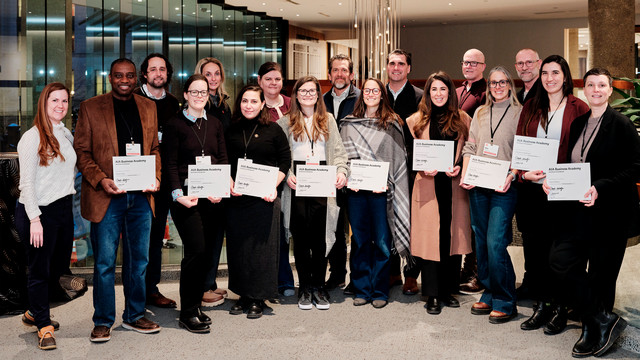
The curriculum blended executive-level strategy with practical implementation in a seven-month learning experience anchored by two in-person, full-day workshops and two virtual sessions in between.
Rather than tailoring every case study to architecture, the faculty deliberately drew from multiple industries, challenging participants to translate proven business frameworks into their own firm contexts.
“The most durable learning happens when participants engage with business cases from a range of industries and do the work of translating those lessons,” Gresham notes. “The breakthrough moments came when they stopped asking for prescriptive answers and started generating their own.”
For Bosse, the workshops are designed to help technical experts expand their leadership toolbelts.
“This style of program works particularly well in industries where leaders’ technical skills can be complemented with stronger business acumen,” Bosse said. “We’re helping them continuously develop their pipeline, their people, and their practices.”
“We learned a great deal about the meaningful work they are doing around the world,” Coughlan said. “The most rewarding aspect was seeing participants apply what we taught so quickly, culminating in presentations on the final day.”
Feedback from the first cohort underscored both the appetite for this education and its immediate impact.
Rebecca Swanner, Workplace Design Leader at HED, described the experience as “thought-provoking, practical, and highly relevant,” noting that the program sparked fresh strategic thinking she was eager to implement.
Another participant, a small-firm owner, shared that the Academy provided dedicated time to step back and define the firm’s future, leading to tangible improvements in goal-setting and profitability.
For many, access was key. As Lori Apfel Cardeli, Owner and Principal of LACArch, observed, “Architects rarely receive formal business training, so having an Academy tailored to the realities of practice is both rare and essential.”
For Gresham, the Academy represents more than a professional development offering; it is part of a broader shift in how the profession sees itself.
“The era of skating by on talent and tradition is over,” she says. “The pressures facing firms today demand leaders fluent in strategy, finance, people systems, and long-term decision-making.”
The long-term goal is a profession led by architects who pair design excellence with strategic clarity and financial stewardship.
A second cohort is already forming, and faculty members are refining the sequence and adjusting content based on participant feedback, embodying the same continuous-improvement mindset they teach.
Architecture has always been about designing structures meant to endure. Through the AIA Business Academy, this partnership is helping firms design something equally important—their own long-term resilience.