25 Years of Rethinking Economic Data
From questioning the accuracy of economic forecasts to helping establish a global research community, the Robins School professor reflects on 25 years of progress.
by Kourtney Ennis, director of marketing, Robins School of Business
When the federal government releases new figures on inflation, economic growth, or employment, those numbers can influence everything from Federal Reserve interest rate decisions to investment strategies. But what happens when the data used to make those decisions later turn out to be inaccurate?
It's a question Dean Croushore, professor of economics and Rigsby Fellow at the Robins School of Business, has spent much of his career studying. His research helped lead to the creation of a major economic database and a conference that recently celebrated its 25th anniversary.
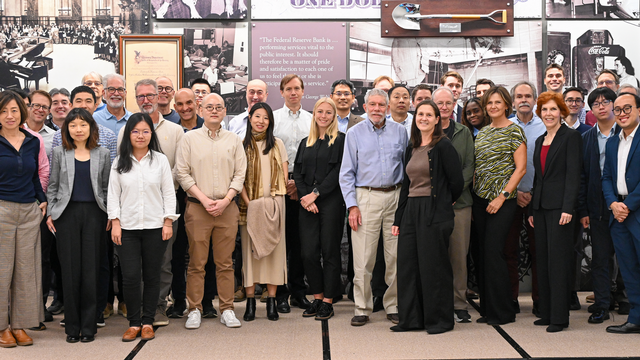
This month, Croushore returned to the Federal Reserve Bank of Philadelphia, where he previously served as vice president and economist, for the 25th anniversary of the Conference on Real-Time Data Analysis, Methods, and Applications. He helped organize the first conference in 2001 and has remained involved in bringing together researchers from around the world.
The conference grew out of Croushore's work at the Philadelphia Fed in the 1990s. While there, he created the Survey of Professional Forecasters, which collects economic predictions from professional economists. Several years later, researchers began developing models they claimed produced more accurate forecasts.
Croushore saw a flaw in those comparisons. Researchers were testing their models against economic data that had undergone years of revisions, rather than the preliminary figures available when the original forecasts were made. Those revisions could significantly change the picture of the economy.
To address the problem, Croushore and his colleague Tom Stark developed the Real-Time Data Set for Macroeconomists, a database that allows researchers to see exactly what economic figures looked like at different points in history.
Their research showed that revisions to major economic indicators, including GDP growth and inflation, were often larger and more consequential than economists had assumed. After presenting their findings at the National Bureau of Economic Research's Summer Institute in 1999, Croushore saw growing interest in the subject. The Philadelphia Fed organized the first real-time data conference in October 2001 to bring researchers together.
"Economists from all over the country came to Philadelphia for it," Croushore recalled.
The gathering also helped establish professional relationships that would last for decades. Among the attendees was University of Richmond professor Rob Dolan, who later helped pave the way for Croushore's arrival at Richmond in 2003.
Twenty-five years later, the conference continues to bring together economists studying forecasting, monetary policy, and economic data. In preparation for the anniversary, Croushore worked with Richmond alum Peterson Haas, now a member of the University's Institutional Effectiveness team, to examine the research presented throughout the conference's history.
They found that papers presented at the conferences had generated more than 30,000 citations in economics literature, reflecting the influence of the research shared over the years.
Croushore sees an even greater impact in how economists now approach their work. Before the development of the real-time database, researchers often overlooked data revisions or assumed they had little effect on their findings. Today, accounting for the information available when forecasts and policy decisions were made has become standard practice.
"Did you use real-time data, and if not, why not?" Croushore said, describing a question now commonly asked at research conferences.
His work also has implications beyond academia. Federal Reserve policymakers rely on economic indicators when deciding whether to adjust interest rates, while businesses and investors use the same figures to make financial decisions.
But initial economic reports often rely on incomplete surveys, with more accurate information becoming available months or even years later. Government agencies must balance the need to release timely information with the accuracy of that information.
Croushore's advice is simple: "Treat recently released data with skepticism."
He believes policymakers should be cautious about responding too aggressively to preliminary figures and investors should avoid making decisions based on short-term fluctuations in economic reports.
While the questions that inspired the first conference remain relevant, the tools researchers use have changed considerably. At this year's conference, economists explored how artificial intelligence and large language models can help analyze documents and identify patterns that would have been difficult to uncover 25 years ago. Advances in computing have also made increasingly sophisticated forecasting models possible.
For Croushore, the anniversary offered an opportunity to reflect on how far the field has come. He is particularly proud of developing a resource that changed economic research and helping establish a community that continues to share new ideas and techniques.
"The fact that we've continued for 25 years shows the value that researchers place on the conferences and the ideas they generate," he said.
Looking ahead, Croushore hopes the next 25 years will bring better forecasting methods and continued contributions to economic policymaking.