Beyond the Bakeoff: How Bench Top Innovations Helps Shape Careers
Now in its sixth year, the program's alumni reflect on how building a business from scratch prepared them for careers in advertising, artificial intelligence, and beyond.
by Kourtney Ennis, director of marketing, Robins School of Business
When Abigail Freytag, ’24, joined Bench Top Innovations at the University of Richmond, she was hoping to gain experience that would help her land a job in advertising. She didn't expect that building a food brand with her classmates would help lay the foundation for the career she'd eventually pursue at Wieden+Kennedy, the New York advertising agency where she now works as a social strategist.
Fellow alumna Alina Enikeeva found a different application for the same experience. As an AI solutions engineer and team lead at Richmond-based RTS Labs, she helps companies develop technology solutions, using many of the same skills she learned while creating and launching a consumer product in Bench Top.
Both credit the program with helping prepare them for their careers, though neither followed the traditional entrepreneurial path of starting a business.
Now in its sixth year, Bench Top Innovations has become a distinctive offering at the Robins School of Business, giving students from across the University the chance to experience what it takes to build and run a company.
Learning Entrepreneurship by Doing
Launched in 2021, Bench Top Innovations brings together 16 students from Richmond's undergraduate schools to develop, launch, and operate a real, revenue-generating business.
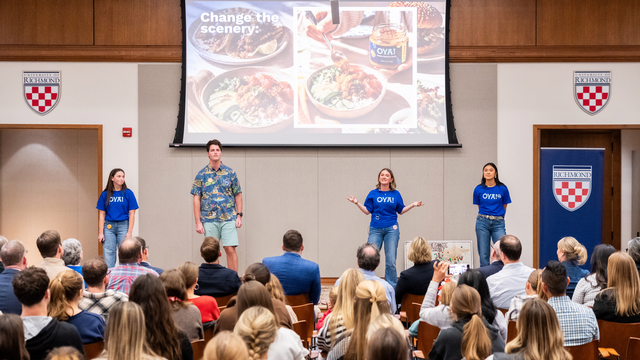
During the first semester, student teams conduct market research, experiment with recipes, develop branding, and pitch their concepts at a competition known as the Great Bake Off. The winning product advances to the second semester, when students form a company and take responsibility for everything from production and marketing to finance, operations, and sales.
Joel Mier, a clinical professor of marketing, and Shane Emmett, an entrepreneur-in-residence and co-founder of Health Warrior, a food company acquired by PepsiCo, founded the program.
While students leave with a better understanding of entrepreneurship, Mier believes the experience teaches them skills that apply to nearly any career.
“Our students learn many things while in the program. Leadership, collaboration, communication, influence without authority, decision-making with imperfect information, all very practical things that will benefit them regardless of the path they take,” he said.
More than anything, he wants students to become comfortable making decisions when there isn't an obvious answer.
“Every choice they make has multiple options, and we never have a clear path. That's uncomfortable. But that's exactly the way life is, and they learn to successfully operate in that environment, a few years ahead of their peers, which I think gives them a huge advantage once they graduate.”
From Building a Brand to Shaping One
Freytag, a business administration major with a marketing concentration and a minor in Latin American, Latino, and Iberian Studies, had her sights set on Wieden+Kennedy long before graduation. She chose courses with that goal in mind, including Bench Top Innovations.
She had heard about the program in Mier's marketing course and was impressed by what previous students had accomplished with their businesses. She was also interested in the opportunity to work with students at Virginia Commonwealth University's Brandcenter on developing brand identities.
During her first semester, Freytag helped develop SPEZIA, a food brand her team created through market research, recipe testing, and collaboration with the Brandcenter.
“It was such a fun creative exercise to work with a team to research, test, ideate, and ultimately create a brand that we believed in,” she recalled. “It was so satisfying to finally land on our perfect recipe and brand identity.”
Although SPEZIA didn't win the Great Bake Off, Freytag gained experience she would later draw on professionally. The following semester, she joined the marketing team for NOOSH, the winning brand, helping prepare for its launch and developing marketing strategies and advertising.
Shortly after graduating in May 2024, Freytag joined Wieden+Kennedy's New York office through its account management residency program. She was hired full-time to work on the Ford account and later transitioned into social strategy.
Today, she works with creative teams to develop content strategies, identify opportunities for Ford to engage with cultural trends, and analyze data to inform the brand's social media presence.
“I am so grateful to have gained real-world brand-building experience in the Bench Top program, given how integral brand strategy is to my role today,” she said. “The foundational knowledge of marketing and brand strategy I developed during my time at the Robins School has shaped the way I approach my work in advertising.”
Once she started working at Wieden+Kennedy, Freytag was surprised by how familiar the creative process felt. Collaborating with designers and strategists, providing feedback, and using research to guide decisions reminded her of working with the VCU Brandcenter during Bench Top.
“It was so cool to realize the parallels and feel more confident approaching my role at Wieden, knowing I had already done something similar,” she said.
The experience also helped her recognize an interest in strategy, which ultimately influenced her decision to move out of account management.
“The course definitely led me in the direction of working at an ad agency, and gave me the confidence to seek a position at WKNY,” she said.
Applying an Entrepreneurial Mindset to AI
Enikeeva came to Bench Top from a different academic background. A double major in computer science and psychology, she had never taken a business course but had always been interested in entrepreneurship.
“I've always wanted to be an entrepreneur, but I never knew where to start,” she said. “Bench Top offered a guided, hands-on experience of building a venture in a very exciting way.”
She appreciated that the program used food as its starting point, making business development easier to understand and less intimidating.
“Online, founders look so polished that it's easy to think they had some secret formula. Bench Top showed me a business is built step by step, through lots of small decisions and experiments.”
As part of the NOOSH team, Enikeeva used her computer science background to build the company's website. She worked closely with classmates focused on marketing and branding to make sure the website reflected the brand they were creating.
“As a computer science student on a team of mostly business students, I took on building the website,” she said. “I learned a lot from how other students thought, and the best results came from combining our perspectives.”
After graduation, Enikeeva joined RTS Labs, an applied AI consulting firm in Richmond, as an AI Solutions Engineer. About a year later, she became a team lead and now mentors three other engineers.
Her work involves helping clients develop tools and automate processes, often taking projects from the initial idea through implementation.
“Just like in Bench Top, it all starts with an idea, and the first question is always, what's our goal?” she said. “The most rewarding part is creating something from nothing and then seeing people actually use it and enjoy it.”
She sees another direct connection between the two experiences: the need to experiment, learn from mistakes, and make adjustments.
In Bench Top, that meant testing ingredients and refining recipes until the team developed a product it wanted to sell. Today, she follows a similar process when developing software for clients.
“With clients, the first version is never the final one. We build a proof of concept, get feedback, and refine it,” she explained. “Knowing that a first attempt is a starting point, not a failure, is something I really lived in Bench Top.”
Working with students from other majors also prepared her for the collaboration required in consulting, where engineers, clients, and business leaders often approach problems differently.
Although she never pursued a business degree, Enikeeva considers Bench Top one of the most valuable courses she took at Richmond.
“Even if you never plan to start a business, the mindset carries into any career—start with the goal, try things, learn from what doesn't work, and keep going.”
Bringing the Business Into the Classroom
Over the past six years, Bench Top has continued to evolve, giving students more resources to support their businesses.
Andrew Ilnicki, director of the Innovation Studio at Richmond, works with students on everything from developing their pitches and refining their presentations to website design and user experience.
He also helps students develop the story behind their brands, working with teams individually to improve their ideas and prepare for presentations.
The program now uses the Innovation Studio, where students can run business operations, store products, and use the University's shipping infrastructure to fulfill e-commerce and business-to-business orders.
For Ilnicki, the combination of classroom learning and actual business operations makes Bench Top particularly valuable.
“This to me is a model class for the future of higher education everywhere,” he said. “It's my favorite class at Richmond, and it leads to life-changing experiences.”
He often shares Freytag's experience at Wieden+Kennedy as an example of how the skills students develop in Bench Top can translate into professional careers.
Mier is equally enthusiastic about what students accomplish, both during the program and after graduation.
“Our students continue to amaze me with their passion and drive and curiosity,” he said. “We are so fortunate to have amazing students who want to challenge themselves and tackle extraordinarily complex hard things. It speaks volumes about who they are as people, and about the amazing things they're going to do in their lives.”
Looking Back, Moving Forward
Six years into Bench Top Innovations, alumni like Freytag and Enikeeva offer a look at how the experience carries into the workplace.
Freytag uses the brand strategy, research, and collaboration skills she developed in the program every day at Wieden+Kennedy. Enikeeva draws on the same approach to experimentation and problem-solving as she develops AI solutions and leads a team of engineers.
Both encourage students to consider the course, whether or not they plan to become entrepreneurs.
“Bench Top Innovations was hands down the best course I took at UR, and I don't think I would be working at my dream agency had I not trusted my gut and applied for the program,” Freytag said.
Enikeeva agrees. “Take it, and I'd say that to any student, not just Robins students,” she said. “It's one of the rare classes where you build something real, and it's a lot of fun.”