Building Stronger Businesses, One Entrepreneur at a Time
The University of Richmond's Minority Business Enterprises Executive Management program gives business owners the tools, connections, and perspective to grow their companies.
by Kourtney Ennis, director of marketing, Robins School of Business
When D.W. Carr Jr. founded his trucking company in 1978, he had one truck, one driver, and a simple goal: to create a job for his unemployed brother-in-law.
More than 45 years later, D.W. Carr Jr. & Sons Trucking has grown to a fleet of about 15 trucks and remains family-owned and operated. Today, four of Carr's children carry on the company he built, navigating an evolving industry while preserving their father's legacy.
Alesia Boney, now chief operating officer, says continuing the family business means strengthening its operations and positioning it for the future.
"We respect the legacy, but we are also willing to change, learn, and improve so the business can remain strong for years to come," she said.
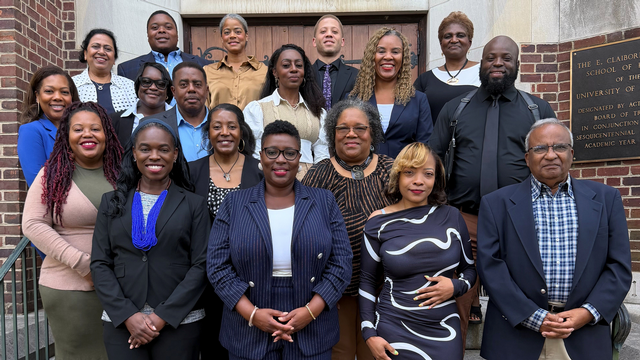
That commitment to growth brought Boney to the University of Richmond's annual Minority Business Enterprises (MBE) Executive Management program, hosted by Executive Education at the Robins School of Business in partnership with The Council.
The program brings business owners together for an intensive learning experience designed to strengthen their leadership and business management skills. Through sessions led by Robins School faculty and opportunities to connect with fellow entrepreneurs, participants explore financial management, strategy, negotiation, technology, and other topics that directly affect their businesses.
For Boney, the experience offered time to think strategically, something that can be difficult to find while managing the demands of a growing company.
"I wanted dedicated time to step away from the day-to-day demands of the business and think more intentionally about where we are going and what it will take to get there," she said.
Like many entrepreneurs, Boney spends much of her time managing immediate operational needs. But as the company looks toward its next chapter, she recognizes that managing daily operations is only part of his responsibility.
"One of my biggest takeaways was that growth has to be intentional," she said. "It is easy to focus on increasing revenue, but the program reinforced the importance of understanding whether that revenue is profitable, what it costs to serve each customer, and whether an opportunity supports the company's long-term strategy."
The program's financial management and strategy sessions were particularly valuable as Boney considered rising insurance, fuel, equipment, maintenance, and labor costs in the trucking industry. She also found practical applications in sessions on negotiation, developing a business pitch, and artificial intelligence. Each provided new ways to evaluate opportunities, communicate the company's value to prospective customers, and improve efficiency.
"What I valued most was how practical the program was," she said. "I was able to take something from every session and connect it directly to our business."
For Marshall Geiger, professor of accounting, helping entrepreneurs develop that perspective has been one of the most rewarding aspects of teaching in the MBE program.
Geiger was part of the original group of Robins School faculty and Executive Education representatives who met with the program's founders to explore bringing the initiative to the University. He has taught its accounting acumen component every year since its inception.
His goal is to make financial concepts more approachable and show business owners how to use accounting information to make better decisions.
"Some are intimidated by it, largely because they have not studied it, or were not properly introduced to it," Geiger said. "So, part of my role is to get them to understand it a little better and to remove (or at least reduce) some of the mystique surrounding accounting."
He sees cash flow planning as one of the most important challenges facing entrepreneurs. While business owners may excel at developing products, serving customers, or identifying opportunities, understanding the financial implications of their decisions is essential to long-term success.
Unlike traditional undergraduate or graduate students, MBE participants bring immediate, real-world challenges into the classroom. They are eager to apply what they learn and often challenge instructors with questions drawn directly from their businesses.
"They are completely committed to learning more in order to improve their businesses, and thereby, improve their lives," Geiger said. "Accordingly, they are actively engaged in everything that we discuss and are eager to learn from not only the instructors, but from each other."
That engagement has led to memorable experiences over the years. Geiger recalls one cohort writing "Accounting Rocks!" on the classroom board before his second session.
Another former participant returned to his office about 18 months after completing the program with a gift to thank him for helping the business reach a point where it could secure a major customer contract.
"That was unforgettably special," Geiger said.
For Geiger, moments like that demonstrate how business education can make a difference well beyond the classroom.
While faculty expertise is central to the program, Boney and Geiger also point to another key benefit: the relationships participants build with one another.
The program brings together business owners from different industries, backgrounds, and experience levels. Some arrive with extensive financial knowledge or formal business training, while others have built successful companies largely through experience.
Those differences create opportunities to exchange ideas and approach familiar challenges from new perspectives.
"Even though our industries may be different, many of the leadership, financial, operational, and growth challenges are very similar," Boney said.
Geiger believes those connections are just as important as the formal instruction.
"One of the great strengths of the MBE program is the connections that they form with other participants," he said. "They now have a group of other entrepreneurs that they can contact for help and support."
The learning goes both ways. Geiger says participants regularly introduce him to emerging industry challenges, changing business practices, and new perspectives that inform his own teaching.
For the Robins School, the MBE program offers an opportunity to extend faculty expertise beyond traditional degree programs and contribute directly to the success of community businesses.
Geiger believes business schools play an important role in supporting entrepreneurs who may not have the resources to pursue customized executive education or consulting services on their own.
"Programs like the MBE program enable us to have a positive, real-time impact on the local business community," he said.
The experience also keeps faculty connected to the challenges business owners face, creating a knowledge exchange that benefits both the University and the entrepreneurs it serves.
For Boney, the program's impact comes back to the future of her family's company.
"I learned that I am capable of thinking bigger about the future of the company and that I need to give myself the space to do that," she said.
For a business that began with one truck and a desire to create opportunity for a family member, that forward-looking perspective is another way of honoring the legacy that started it all.